

The menu

Every plate
has a reason

Twenty-two plates. Ten Signatures named into the house world, twelve Classics named plainly. Open any one and it will tell you where it came from and what we changed.

V  —  Vegetarian Tandoor  —  Cooked in the tandoor
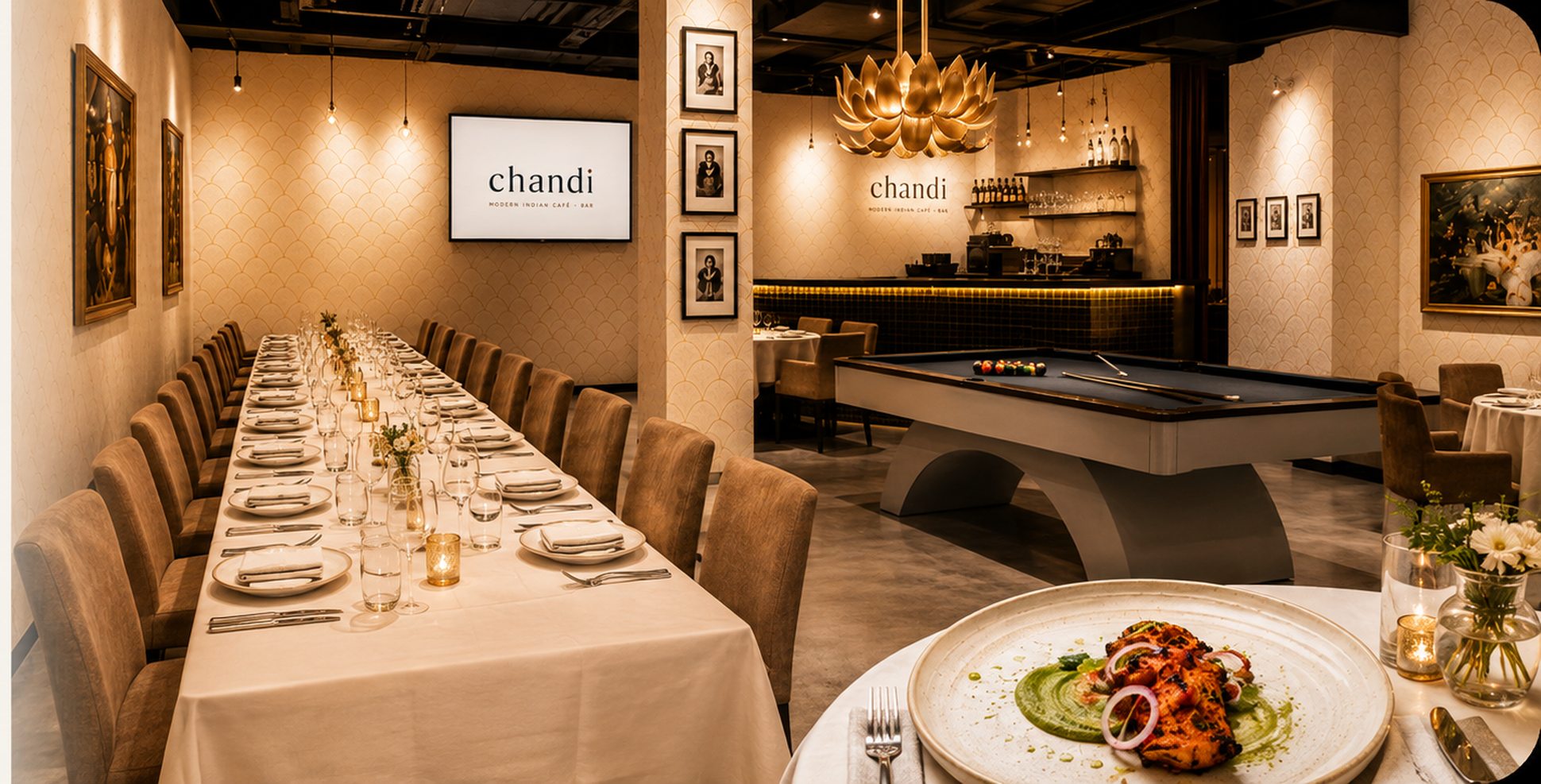
The chandi dining room — long table, pool table and the bar beyond
01 To begin 8 plates

Small plates. Most tables order three or four to share before anything else arrives.

01

NightgardenSignatureVTandoor

Tandoori cauliflower and paneer, almond makhani, burnt chilli, micro herbs.

The story

A whole cauliflower, brined overnight and put into the fire.

Cauliflower is the vegetable Indian kitchens treat worst — boiled into a curry until it surrenders. This does the opposite. The head is brined overnight so it seasons all the way through, then taken into the tandoor whole and left there until the outer florets blacken and the heart steams itself soft inside its own leaves. It comes out tasting of two things at once: smoke on the outside, sweetness at the centre.

What makes it oursThe makhani underneath is the argument. Butter-masala is almost always thickened with cashew, which makes it heavy and mutes the tomato. Ours is rebuilt on blanched almond — lighter, cleaner, and the tomato finally comes through. Burnt chilli is scattered over at the pass rather than stirred in, so the heat arrives a beat late, after the sweetness has registered.

02

High TideSignatureTandoor

Tandoori tiger prawns, dried-shrimp and Kashmiri-chilli XO, kaffir lime.

The story

Ninety seconds in the tandoor. There is no margin in that.

Tiger prawns go into the fire for barely a minute and a half — long enough to take colour and pick up smoke, short enough that the centre stays translucent. A second too long and they are rubber. The name is the hour rather than the tide chart: this is what the coast tastes like at the top of an evening, not at noon.

What makes it oursThe sauce is an XO built the Indian way. The Cantonese original is dried scallop, ham and chilli oil; ours swaps in dried shrimp and Kashmiri chilli, drops the pork entirely, and cooks down until it turns sticky and almost black. A leaf of kaffir lime is bruised over the plate as it leaves the pass — you smell it before it reaches the table.

03

Silver ThreadSignatureTandoor

Malai chicken tikka, cream-cheese and cardamom marinade, white miso and yuzu-kosho glaze.

The story

The gentlest thing the tandoor makes, then a hard turn at the end.

Malai tikka is the quiet corner of the tandoor repertoire: chicken thigh in cream cheese and green cardamom, no chilli, no colour, cooked only until the edges catch. Most kitchens serve it exactly there and it is pleasant and forgettable. The thread in the name is the single line of char that runs down each piece.

What makes it oursIn the last thirty seconds it is brushed with white miso and yuzu kosho. Because the glaze goes on late it sits on the surface rather than soaking in, so the first thing you get is salt and citrus, and the cardamom arrives underneath a moment later. Two kitchens, in the right order.

04

Samosa ChaatV

Crushed samosa, chickpea, tamarind and mint chutneys, yoghurt.

The story

Crushed at the pass, not served whole.

The samosa is made in house and then broken open at the last moment, so the pastry shatters into the chickpeas underneath rather than sitting on top going soft. It should be eaten immediately, while it is still loud.

What makes it oursTamarind and mint go over in two separate pours, never mixed together first — so you get each one on its own before they meet in the bowl. Set yoghurt is spooned on last, cold against everything else.

05

Paneer TikkaVTandoor

Tandoor-grilled paneer, mint chutney.

The story

Set in house, cut thick, and left alone.

Paneer made on the premises has a texture bought paneer never has: it holds together on the skewer but gives when you bite it. Cut thick, marinated in yoghurt with ginger and carom, and given the tandoor until the corners blister and catch.

What makes it oursMint chutney on the side. Nothing more, because nothing more is needed — and a kitchen that adds more to this is usually covering for the paneer.

06

Chicken TikkaTandoor

Spiced yoghurt marinade, tandoor char.

The story

Thigh, not breast. Overnight, not an hour.

The marinade is spiced yoghurt and it is held overnight, so the acid works slowly through the meat rather than seizing the surface. Thigh because it has the fat to survive the fire; breast goes dry in a tandoor and every kitchen that uses it knows this.

What makes it oursCooked hot and fast, turned exactly once. The char is the seasoning.

07

Amritsari Fish

Crisp-battered fish, mint chutney.

The story

A rough, blistered crust — never a smooth one.

The batter is gram flour with carom and ajwain, and the trick is in how it sets: it should break into an uneven, blistered shell rather than the smooth jacket a wheat batter gives. Amritsar does this with river fish pulled from the Ravi.

What makes it oursWe do it with a firm white fillet and change nothing else about it. Mint chutney and a wedge of lime.

08

Lamb Seekh KebabTandoor

Minced lamb skewer from the tandoor.

The story

Worked until it is smooth enough to hold to the skewer.

Minced lamb, green chilli and coriander are worked by hand until the mixture turns tacky and will cling to a metal skewer without binder. That working is the whole technique; get it wrong and the kebab drops into the coals.

What makes it oursCooked over the tandoor's hottest zone so the outside sets before the inside overcooks. Served off the skewer, with onion, and no sauce.

02 The mains 10 plates

Larger plates, built to be shared down the middle of the table.

01

Smoke and ShadowSignatureTandoor

Tandoori lamb chop, black-cardamom glaze, mint and pistachio.

The story

Black cardamom, and no apology for it.

Frenched lamb chops are marinated in yoghurt and black cardamom — the smoked pod, not the green one — then hung in the tandoor so the fat renders down through the meat as it cooks rather than dripping away. They come out with a crust and a centre that is still pink.

What makes it oursBlack cardamom is the most divisive spice in the Indian pantry: camphorous, faintly medicinal, closer to woodsmoke than to sweetness. Half the table will love it and half will not, and that is the point of putting it on a menu rather than hiding it in a masala. Mint and pistachio go on at the end to cut through. Eat these with your hands.

02

Blue HourSignatureTandoor

Tandoori half lobster, makhani bisque, micro herbs.

The story

Where the two kitchens meet most directly.

Half a lobster, split, brushed with butter and given the tandoor's dry heat rather than a poach. The shell protects the meat from the worst of it and the smoke gets in anyway. L'heure bleue is the twenty minutes after sunset when the sky is neither one thing nor the other — which is roughly when this plate makes sense.

What makes it oursUnderneath is a makhani reduced to a bisque: the same butter-masala foundation, but built on the roasted shells, strained twice and finished with cream. That is French method holding an Indian sauce, and it is the clearest statement of what this kitchen is doing. Nothing on the plate is a garnish.

03

The Midnight DalSignatureV

Black urad simmered twenty-four hours, white miso, cultured butter.

The story

Twenty-four hours. It is the first thing the kitchen starts and the last thing it finishes.

Black urad is soaked, then held for a full day over the lowest heat the range will hold. Nothing is rushed and nothing is stirred hard. Somewhere around hour eighteen the lentils stop being lentils and collapse into each other, and the pot turns glossy and almost black.

What makes it oursWhere a classic dal makhani closes with cream and more butter, this one finishes with white miso and cultured butter. The miso does not read as Japanese — it reads as more time, a savoury depth you would swear came from another six hours on the heat. The cultured butter brings a faint sourness that keeps it from being cloying. Deep, dark and quiet.

04

NimbusSignature

Peppery Chettinad chicken folded through coconut-milk risotto, curry-leaf oil.

The story

The most heavily peppered cooking in India, folded into a risotto.

Chettinad is Tamil country cooking and it runs on black pepper rather than chilli — a heat that builds at the back of the throat instead of hitting the front of the tongue. The chicken is cooked in that masala first, so it carries the pepper before it meets anything else.

What makes it oursThen it is folded through a risotto made with coconut milk instead of stock and finished without cheese, because cheese would flatten it. The rice carries the pepper and softens its edges. Curry-leaf oil goes over at the last moment — bright green, and smelling exactly like the tempering pan it came from.

05

MalabarSignature

Pan-seared seabass, Alleppey coconut and raw-mango curry, lemongrass, red rice.

The story

The coast where the pepper trade started, and where every kitchen since arrived from.

Seabass, skin scored and seared hard so it stays crisp under the sauce, laid into an Alleppey curry. Alleppey is the Keralan style built on coconut and raw green mango — sour rather than sweet, with turmeric doing the colouring rather than chilli. It is the curry that tastes of the backwaters.

What makes it oursLemongrass is not traditional and is in there deliberately, holding the sourness up so it does not slump into the coconut. It comes with red rice rather than basmati: nuttier, chewier, and able to stand up to a sauce that would drown a finer grain.

06

Butter Chicken

Tandoori chicken in a silken makhani, warm kulcha.

The story

The one everybody knows, done the way it is supposed to be done.

The chicken goes through the tandoor before it goes anywhere near the gravy. This is the step most kitchens skip because it costs a stage and a piece of equipment, and it is the entire difference between a good makhani and a forgettable one — the smoke is in the meat, not in the sauce.

What makes it oursThen into a silken tomato and butter gravy finished with cream, and warm kulcha to move it around the plate.

07

Dal MakhaniV

Slow black lentils, butter, cream.

The story

The same lentil as the Midnight Dal, taken the other way.

Black urad, cooked long, finished the traditional way with butter and cream rather than miso. Richer, rounder, more familiar.

What makes it oursThe Midnight Dal is the argument; this is the answer. Both are on the menu on purpose, and most tables end up ordering both to see.

08

Rogan Josh

Kashmiri slow-cooked lamb, saffron pilaf.

The story

Red from the chilli and the root, never from tomato.

Kashmiri rogan josh takes its colour from dried Kashmiri chilli and ratanjot — alkanet root — rather than from tomato, which is why it is deep red and yet barely hot. Lamb shoulder is cooked until it gives way to a spoon.

What makes it oursFennel and dry ginger do the aromatic work in place of onion and garlic, which is the Kashmiri Pandit way. Saffron pilaf alongside.

09

Palak PaneerV

Paneer in spiced spinach.

The story

Green, because it was not overcooked.

Spinach is blanched and refreshed immediately in ice so it stays actually green rather than turning the grey-brown of a dish that has been sitting. That single step is what separates this from most versions of it.

What makes it oursBlitzed coarse rather than smooth, so you can still tell it is a leaf, with the paneer folded in at the very end so it keeps its texture. A bright garlic tempering over the top.

10

Chicken Biryani

Saffron basmati, sealed and steamed, burhani raita.

The story

Sealed under dough, and opened at your table.

Cooked on the dum: layered raw with saffron basmati, sealed under a ring of wheat dough, and finished in nothing but its own steam. Nothing is stirred and nothing is checked — once the seal is on, the pot is committed.

What makes it oursIt is carried to your table sealed and broken open in front of you, because the first rush of steam is a third of the dish. Burhani raita, garlicky and thin, to pour over.

03 To close 4 plates

Four ways to finish, one of which cannot be made any other way.

01

Chandni ki ChaatSignatureV

Overnight saffron milk-froth, pistachio, edible silver.

Limited each service. When it is gone, it is gone.
The story

The reason the room has its name.

There is a real Old Delhi sweet, made only in the cold months and sold only at dawn. Milk is sweetened, whipped to a foam, and left out overnight under the dew so it sets in the cold air. It is so light that it collapses by mid-morning. It cannot be transported and it cannot be kept, which is why almost nobody outside Chandni Chowk has eaten it.

What makes it oursOurs is churned the night before with saffron, set over crushed pistachio and finished with edible silver. It is made in limited number each service because it cannot be made any other way. When it is gone it is gone, and we will not pretend otherwise.

02

Saffron BlancSignatureV

Warm saffron and white-chocolate fondant, cardamom, pistachio brittle.

The story

Into the oven to order. Out with the centre still moving.

A fondant built on white chocolate rather than dark, which is harder to get right — there is no cocoa bitterness to hide behind, so the saffron has to carry it. The saffron is steeped into the cream before anything else happens, so the colour comes through pale gold rather than the flat yellow you get from adding it late.

What makes it oursCardamom is ground fresh into the batter, not from a jar. The brittle is pistachio, snapped rather than cut, entirely for the noise it makes when it goes on the plate.

03

Chocolate and Chai BrownieV

Warm masala-chai brownie, vanilla.

The story

The chai arrives after the chocolate, not alongside it.

Masala chai is brewed strong and then reduced right down before it goes into the batter, so it concentrates rather than dilutes. Baked short, so the middle stays dense.

What makes it oursThe order matters: chocolate lands first, then cardamom and ginger come up behind it a second later. Served warm, with vanilla on the side.

04

Saffron CheesecakeV

Baked saffron and cardamom cheesecake, nankhatai crumb.

The story

Baked, not set. And the base is not a digestive.

Baked rather than gelatine-set, with saffron and cardamom worked through the curd so the flavour is in the body of it rather than sitting on top.

What makes it oursThe base is crushed nankhatai — the Indian semolina shortbread, crumbly and faintly savoury from the ghee. It works far better under a cheesecake than a digestive biscuit does, because it has salt and structure instead of just sugar.

Twenty-two plates · open any one for the story

The bar

Drinks

A full bar with its own service, open as long as you are. On a private buyout it runs to your evening, not to a last-orders bell.

01 Cocktails 6

Six, made properly. No theatre, no smoke box, no foam.

01

Old Fashioned

Bourbon, demerara, aromatic bitters, orange oil

02

Negroni

Gin, Campari, sweet vermouth — stirred down, big cube

03

Espresso Martini

Vodka, fresh espresso from the café machine, coffee liqueur

04

Margarita

Blanco tequila, lime, triple sec, salt on one side only

05

Whisky Sour

Bourbon, lemon, egg white, Angostura

06

Aperol Spritz

Aperol, prosecco, soda, half an orange wheel

02 Whisky 8

Eight pours. 30ml, or take the bottle to the table.

01

Jameson

Ireland · blended

02

Monkey Shoulder

Scotland · blended malt

03

Glenfiddich 12

Speyside · single malt

04

The Balvenie 12 DoubleWood

Speyside · single malt

05

Laphroaig 10

Islay · single malt, heavily peated

06

Lagavulin 16

Islay · single malt

07

Hibiki Harmony

Japan · blended

08

Yamazaki 12

Japan · single malt

03 Beer 6

One on tap, five in the bottle.

01

Stella Artois

On tap · Belgium · pint

02

Tiger

Bottle · Singapore

03

Heineken

Bottle · Netherlands

04

Corona

Bottle · Mexico

05

Asahi Super Dry

Bottle · Japan

06

Guinness

Bottle · Ireland · stout

The whole place, from S$380++